






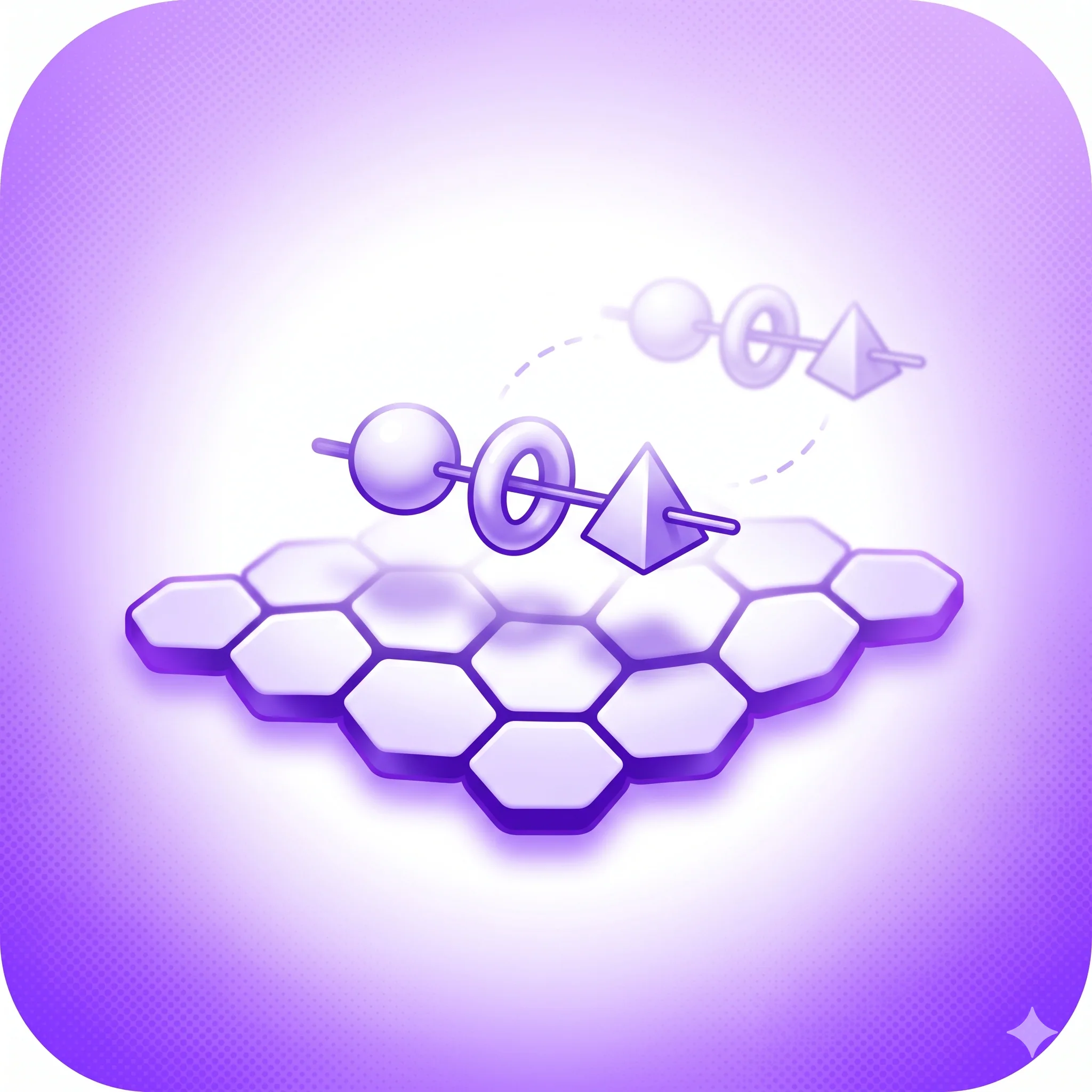

Cognitive maps
Structured maps as a substrate for analogy and counterfactual, drawn from neuroscience and tested against our own memory library.
One architecture on a continuous axis — reared on the stack.
Explore LoominumEnterprise
Research
Science
About
Cognitive maps, structured binding, and how the brain composes — applied to artificial cognition.
A growing body of neuroscience suggests cognition is supported by structured maps that bind entities to roles and compose across domains. Our science program treats this seriously: we build artificial systems that share those organising principles, and we evaluate them against tasks designed to discriminate composition from memorisation.
flatten entities, roles, and worlds into one embedding space and hope a deeper net untangles them again.
cognitive maps treat entities, roles, and worlds as separate structural objects, and we evaluate against tasks that punish you for ever folding them.
Structured maps as a substrate for analogy and counterfactual, drawn from neuroscience and tested against our own memory library.
How role-filler binding behaves under role swap and held-out evaluation — and what falls out when it does not.
How long-term memory consolidates without overwriting earlier worlds, measured against amnesiac controls.
Held-out, multi-seed. The same model class evaluated under two binding regimes. Where the system has explicit slots, role swap and held-out combinations are not adversarial.
The win is the binding regime, not the architecture. We measure the same backbone family in both columns so the comparison isolates the structural choice.
A controller that consolidates retains every world it has seen. An amnesiac controller — same data, same compute, no consolidation — loses earlier worlds as new ones arrive.
The bet that survives is on objective and binding. Where a tempting architectural claim does not, we say so on the page.
Under a clean A/B test where two backbones share the same learning rule, the developmental substrate does not beat a strong transformer on lifelong retention. We say so.
measured · retain 0.66 ± 0.25 vs 0.94 ± 0.03
A transformer reaches a perfect naming score on the same harness. The win in naming is the objective and the rearing, not the substrate.
measured · transformer naming = 1.00 held-out
Across n=5 seeds the gap between the developmental and the strong baseline is well inside the error bars. We do not claim a substrate win there.
measured · gap inside ± 0.24
We publish negatives. Where an architecture-priors claim does not survive a clean A/B test, we say so. The bet that survives is on objective and binding, not on which substrate you stamp on top.
The same binding and consolidation primitives surface across our research programs — structured memory, evals, alignment — and through every long-running production system we ship.