




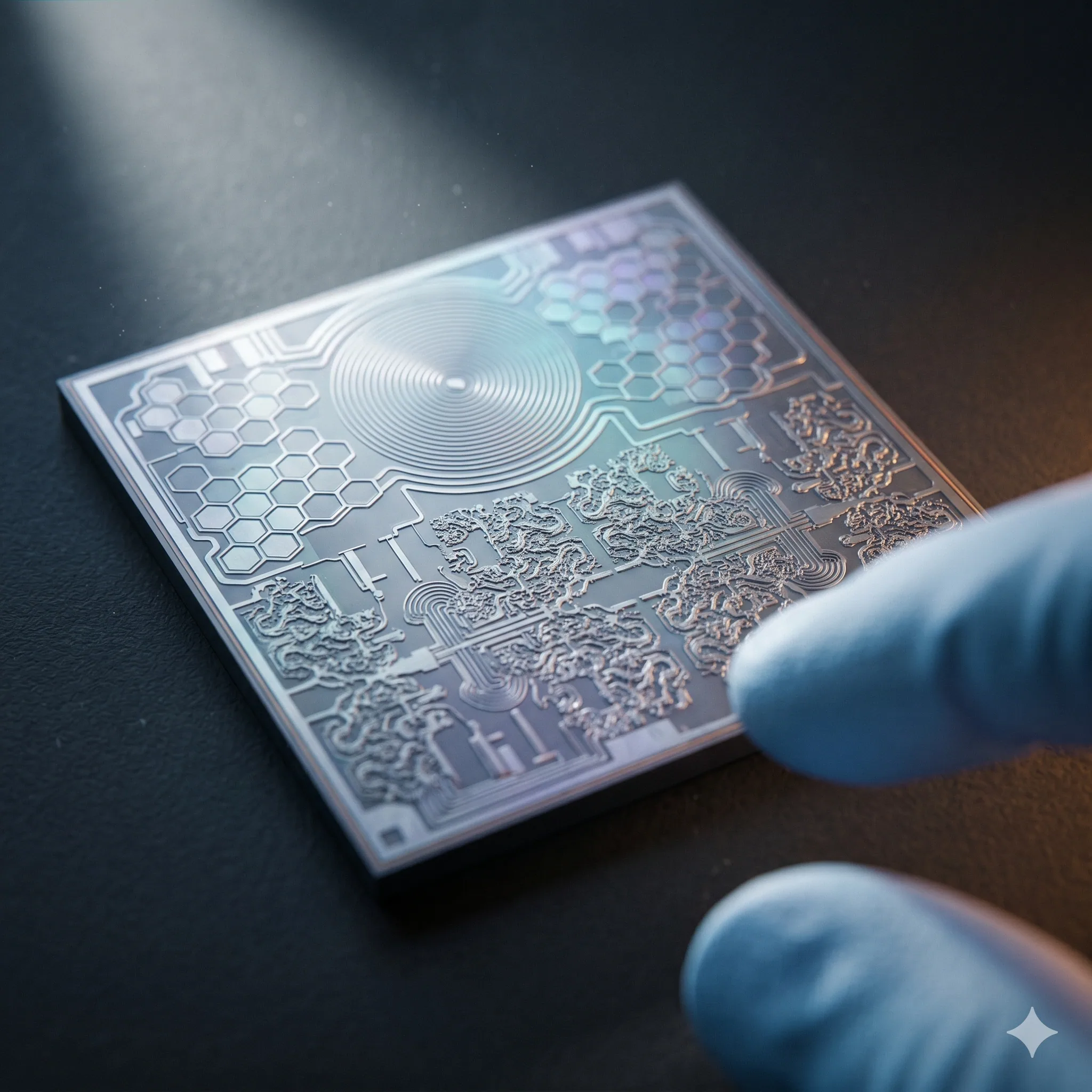



Curvature-native layout
Floor plans organised around the geometric primitives the cognitive substrate uses.
One architecture on a continuous axis — reared on the stack.
Explore LoominumEnterprise
Research
Science
About
Curvature-native compute substrates and the physics of doing more with less.
Our materials-and-silicon program studies how the geometry of a substrate constrains the cognition it can support. The work spans analog block design, layout that respects locality, and a security drop-in that puts the root of trust inside the same fabric as compute.
geometry is a constraint imposed by the foundry that the architect spends effort fighting against.
geometry is part of the cognitive substrate — when layout, analog references, and root-of-trust share the same organising principle, locality and energy are free.
Floor plans organised around the geometric primitives the cognitive substrate uses.
Bandgap, PTAT, and sense paths designed against the cognitive primitives, not retrofitted to fit them.
Sealed storage, lockout, and post-quantum signing live inside the chip, not bolted on after the fact.
The analog corner of the substrate is small but load-bearing. We track each block by its honest status — IP-grade, SPICE-validated, in design, or in layout.
reference voltage, temperature-invariant target
proportional-to-absolute-temperature current source
low-offset comparator on the cognitive sense path
matched-pair layout under symmetry constraints
Sealed storage, lockout, and post-quantum signing live alongside compute — the same die, the same provenance, the same audit.
The differentiating bet is that the substrate and the silicon share an organising principle. Where they do, the system gets locality and energy for free, because the physics is already doing the work the abstraction would otherwise have to enforce.
Where each lives in its own discipline elsewhere, we ship them as parts of the same material. The engineering surface is at geometry-native; the cognitive substrate is at cognition & memory.